The requirements
Every data project starts with understanding what you need to build. This project had two goals.
1 · Build the warehouse (data engineering)
- Build a modern data warehouse in PostgreSQL
- Sources: Transfermarkt data from Kaggle, as CSV files about players, games and competitions
- Quality: cleanse and fix data issues before analysis
- Integration: combine the sources into one user-friendly model
- Scope: the latest dataset only — no historisation needed
- Documentation: clearly document the data model
2 · Analytics and reporting (data analysis)
Build SQL-based analytics with insights into:
- Team behaviour
- Player performance
- Match predictions
Planning the work
I broke the project into epics, each with analysing, coding, validating and documenting steps.
| Epic | Tasks |
|---|---|
| Requirements analysis | Analyse and understand the requirements |
| Design the architecture | Choose an approach · design the layers · draw the architecture |
| Project initialisation | Detailed tasks · naming conventions · Git repository · database and schemas |
| Bronze layer | Analyse source systems · ingest data · check completeness and schema · draw the data flow · commit |
| Silver layer | Explore the data · clean it · check correctness · commit |
| Gold layer | Explore business objects · integrate data · check integration · draw the star schema · create a data catalogue · extend the data flow · commit |
Naming conventions
Without agreed rules, names quickly drift: one developer writes dimension_players, another DimensionClubs, another dim_Competitions. Everything becomes harder to query. So I set rules up front.
- snake_case — lowercase words separated by underscores.
- English for all names.
- No SQL reserved words as object names.
| Object | Pattern | Example |
|---|---|---|
| Bronze and silver tables | <source>_<entity> — keep the original table name | players_transfers |
| Gold dimension tables | dim_<entity> | dim_player |
| Gold fact tables | fact_<entity> | fact_transfers |
| Aggregated tables | agg_<entity> | agg_transfers_monthly |
| Surrogate keys | <table>_key | player_key |
| Technical columns | dwh_<column> | dwh_created_at |
| Load procedures | load_<layer> | load_silver |
Repository, database and schemas
I created a Git repository with a folder for each layer's scripts, then created the FootballDataWarehouse database in pgAdmin 4. One schema per layer keeps everything separate:
-- Create schemas for the medallion architecture
CREATE SCHEMA IF NOT EXISTS bronze;
CREATE SCHEMA IF NOT EXISTS silver;
CREATE SCHEMA IF NOT EXISTS gold;
Building the bronze layer
The bronze layer stores the raw data exactly as it arrives. There are four steps: analyse the source, write the ingestion code, validate it, and document it.
1. Analyse the source systems
In a real organisation, you'd interview the people who own the source systems. These are the questions worth asking:
Business context
- Who owns the data?
- What process does it support?
- Is there documentation, a data model or a catalogue?
Technology
- Where is it stored? (Postgres, Oracle, cloud…)
- How can we connect? (API, Kafka, file extracts, direct database)
Extract and load
- Full or incremental loads?
- How much history do we need?
- How big are the extracts?
- How do we avoid slowing the source down?
- What access or authentication is needed?
2. Create the tables
The table definitions (DDL — data definition language) mirror the source files exactly. Here's the players table:
CREATE TABLE IF NOT EXISTS bronze.players_details (
    player_id INTEGER,
    first_name TEXT,
    last_name TEXT,
    "name" TEXT,
    last_season INTEGER,
    current_club_id INTEGER,
    country_of_birth TEXT,
    country_of_citizenship TEXT,
    date_of_birth TEXT,
    "position" TEXT,
    sub_position TEXT,
    foot TEXT,
    height_in_cm INTEGER,
    contract_expiration_date TEXT,
    agent_name TEXT,
    international_caps INTEGER,
    international_goals INTEGER,
    market_value_in_eur NUMERIC,
    highest_market_value_in_eur NUMERIC
    -- ...plus a few more columns from the source file
);
3. Load the data
PostgreSQL can't load straight from a folder of files on its own, so I wrote a small Bash script. It empties each bronze table and reloads it from the matching CSV — a full load using truncate and insert.
DB_NAME="FootballDataWarehouse"
DB_USER="postgres"
DATA_PATH="./data"

echo "Loading bronze layer..."

psql -U $DB_USER -d $DB_NAME <<EOF
TRUNCATE TABLE bronze.players_details;
\copy bronze.players_details FROM '$DATA_PATH/players/players.csv' WITH (FORMAT CSV, HEADER true, DELIMITER ',');

TRUNCATE TABLE bronze.players_transfers;
\copy bronze.players_transfers FROM '$DATA_PATH/players/transfers.csv' WITH (FORMAT CSV, HEADER true, DELIMITER ',');

TRUNCATE TABLE bronze.games_details;
\copy bronze.games_details FROM '$DATA_PATH/games/games.csv' WITH (FORMAT CSV, HEADER true, DELIMITER ',');

-- ...and the same for the other bronze tables
EOF
4. Validate and document
To check completeness, I compared the number of rows in each table with the CSV files — simple SELECT queries were enough to confirm nothing was missing. Then I drew the data flow and committed the code.
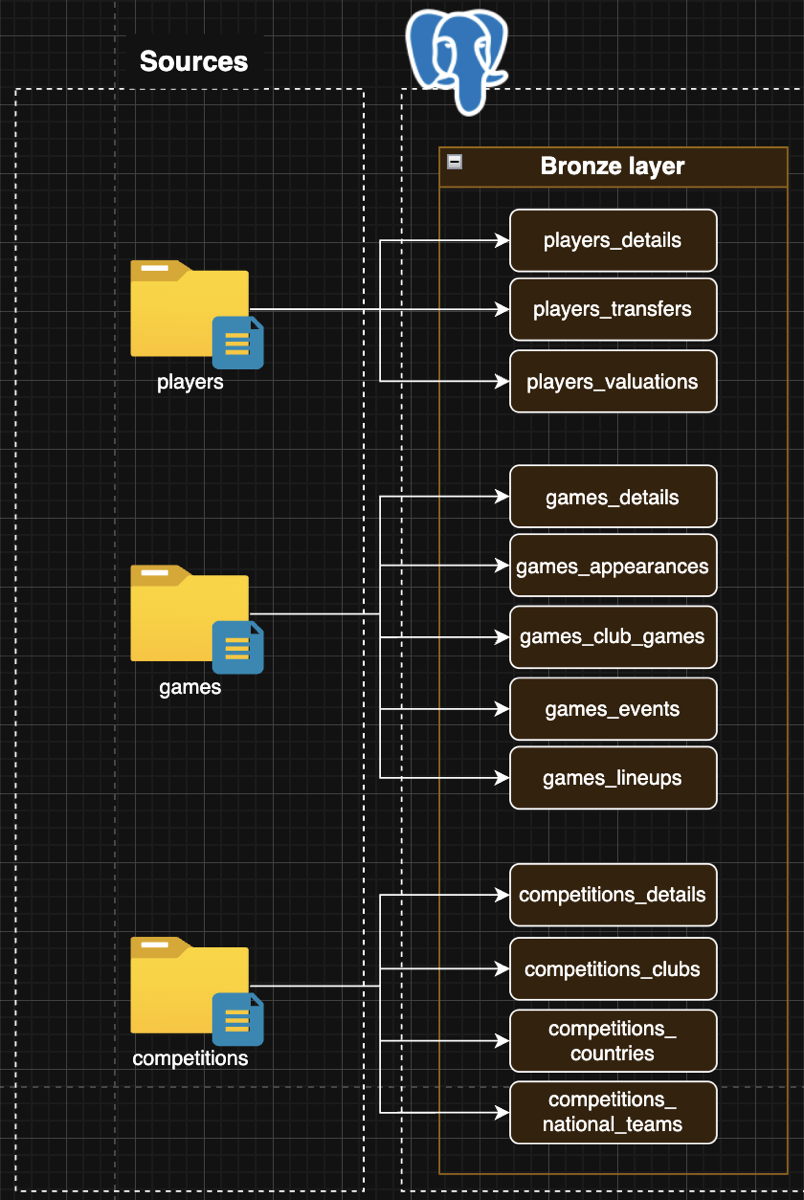
In the next part, the real work begins: exploring and cleaning the data in the silver layer.